


What if the biggest problem with your book marketing isn’t too little effort?
What if it’s too much?
Too many audiences. Overloaded platforms. Competing messages. Endless ideas about what your book could become.
Authors come to me with a long list of things they think they should do: LinkedIn, podcasts, speaking, Substack, articles, media outreach, bulk sales, workshops, courses, partnerships, social media, and more.
None of these ideas is wrong.
The problem starts when you chase them all at once. You spread your time, attention, and energy across ten marketing activities, and none gets enough focus to gain traction. Then you decide your marketing doesn’t work.
The answer isn’t more activity.
Rather, it’s focusing on ONE.
I thought about this again after reading Mark Thompson’s article, ONE Is the Magic Number. Mark applies the idea to building an online business: concentrate on a small number of important things long enough to make them work before you add more.
Nonfiction authors need this same discipline.
Start With ONE Reader
Many authors tell me their book is for “everyone who…”
And that’s often where the trouble starts.
Your book may have the potential to help many kinds of people, but your marketing needs one specific person in mind.
Instead of people approaching retirement.
Consider a successful professional in their early sixties who spent decades building a career and suddenly wonders, Who am I when the job disappears?
Instead of leaders in general.
Consider the newly promoted manager who excelled at doing the work and now has to figure out how to lead the people doing it.
The sharper your picture of your reader, the easier every marketing decision becomes. You understand what worries them. You know what they want. You recognize the language they use. You can find where they gather. And, most important is they recognize themselves when they see your message.
Ask yourself: if you could put your book into the hands of only one type of reader for the next six months, who would you choose?
Start there.
Choose ONE Problem You Want to Be Known For
This part trips authors up because your book often contains dozens of ideas. Five frameworks, twelve chapters, twenty-seven stories, and enough expertise to speak about your subject for three days.
Your reader doesn’t need all of it before deciding whether you matter to them. They need one reason to pay attention.
Authority begins with this question: What problem do you want people to associate with you?
If someone hears your name and thinks, She’s the person who helps authors sell books in bulk, that’s useful.
Yet, if they think, She knows publishing and marketing and speaking and publicity and social media and branding and podcasts and…, you sound accomplished. And, you’re also harder to remember, because people aren’t sure as to where your main expertise lies.
Authority grows when people know what to come to you for.
Pick your one. And know you can expand on it later.
Focus on ONE Audience Before Chasing Five
Here’s another temptation I see all the time. An author identifies several possible markets: corporations, associations, universities, healthcare organizations, nonprofits, coaches, consultants, financial planners. Suddenly the marketing plan looks like a restaurant menu.
Again, none of these audiences is wrong. But you don’t have to run after all of them at once.
Choose the market where three things overlap:
Your book solves an important problem.
The organization can reach many of your ideal readers.
A reason exists for them to buy, hire, invite, recommend, or partner with you.
Then go deeper to uncover:
Who makes the decisions?
What organizations already serve this audience?
What conferences do they attend?
What publications do they read?
What podcasts do they listen to? What problems keep coming up?
You’ll learn far more by understanding one market well than by skimming across seven.
Build ONE Primary Opportunity Around Your Book
Here's where I challenge traditional book marketing. Your book isn't the end product. It's the door opener to umpteen opportunities.
So ask: What do you most want your book to lead to?
It could be…
Bulk book sales
Speaking engagements
Corporate workshops
Consulting
Coaching
Association partnerships
Media interviews
Training programs
Choose one as your primary objective, and this choice changes how you market.
Same book. Very different marketing.
The clearer the destination, the easier the road becomes.
Commit to ONE Primary Visibility Channel
Authors often ask me: Should I be on LinkedIn? Should I start a Substack? Should I make videos? Should I pitch podcasts?
My answer is usually another question: where are the people you want to reach?
You don’t need to be everywhere. You need to be visible where your peeps congregate.
If your audience consists of corporate decision-makers, LinkedIn deserves your attention. If your ideas lend themselves to deeper teaching, a newsletter or Substack makes sense. If your strength is conversation, podcast interviews become a strong authority-building tool. If speaking opens the doors you want, professional associations need to become your primary platform.
Pick one primary channel and learn how to use it well. This doesn’t mean you can never appear elsewhere. It means you stop trying to become good at everything at the same time.
Create ONE Message and Repeat It
From experience, I can attest that this could be the hardest part, because authors get bored long before their audience does. I know becasue I’ve fallen into this trap many times.
You say something three times and think, I’ve already talked about this.
Your audience thinks, I’m beginning to understand what she stands for.
A huge difference separates these two reactions.
Your strongest message should appear in your articles, podcast interviews, presentations, social posts, conversations, email signature, speaker introduction, website, and media pitches. Not word for word. The central idea should stay recognizable.
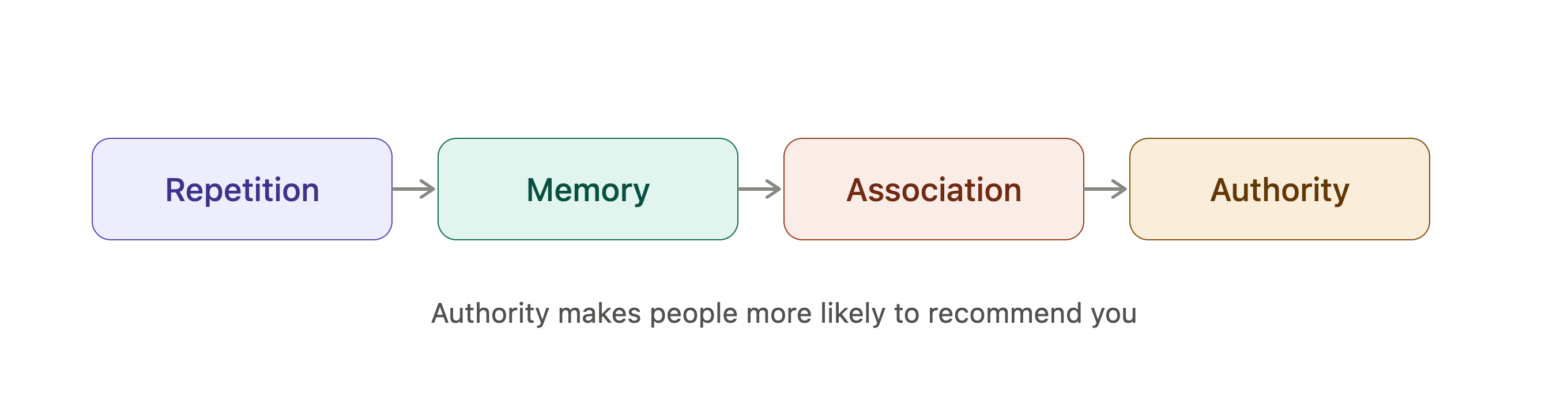
Repetition leads to memory, memory leads to association, association leads to authority, and authority leads to recommendation.
Give ONE Strategy Enough Time to Work
This is the least glamorous marketing advice you’ll get from me: stick with something.
Authors quit strategies before they’ve learned enough to make them work. Three podcast pitches don’t land interviews, so they stop. Four LinkedIn posts don’t produce clients, so they pivot. One corporate buyer says no, and suddenly bulk sales “don’t work.” Then the next strategy starts. And the next. And the next.
You never gather enough evidence to know what your market responds to.
Consistency doesn’t mean you repeat something ineffective forever. It means you give a sound strategy enough time to teach you something.
Your ONE Marketing Challenge
For the next 90 days, resist the temptation to add another marketing tactic. Instead, define your ONEs.
ONE reader. Who most needs your book?
ONE problem. What do you want to become known for solving?
ONE audience. Which market gives you the best opportunity to reach those readers?
ONE outcome. What do you want your book to lead to?
ONE visibility channel. Where will you show up consistently?
ONE message. What idea do you want people to remember and repeat?
Then give yourself enough time to learn what works. You can add another audience, platform, offer, or strategy later.
Expansion works best after you’ve created traction.
Most authors don’t have a shortage of marketing possibilities. They have a shortage of focus. And in a world telling you to post more, create more, appear everywhere, launch more, and feed every platform, doing ONE thing exceptionally well is one of the smartest marketing decisions you make.
So before you ask, “What else should I be doing to market my book?” ask:
What ONE thing deserves more of my attention?
I guarantee your answer will do more for your book than another ten-item marketing plan.
Inspired by Mark Thompson’s “ONE Is the Magic Number” and his idea of concentrating your efforts before you expand.
In Thursday’s paid follow-up to “Your Book Marketing Doesn’t Need More. It Needs ONE.”
Knowing your ONEs is the first step.
The harder part is turning them into decisions you can use. This is where most authors get stuck. They understand the idea of focus, but they still have too many good options competing for attention.
In the paid edition, I’m going to help you narrow those choices and turn this concept into a practical ONE Book Marketing Plan you can actually follow.
You’ll identify your:
ONE reader
ONE problem
ONE market
ONE outcome
ONE visibility channel
ONE core message
ONE 90-day priority
Because focus only works when you know exactly what to focus on.I walk you through a simple authority-building exercise to help you clarify what you want to be known for, who you most want to reach, and whether your current marketing supports that goal.
Paid subscribers will discover how to build their ONE Book Marketing Plan.