


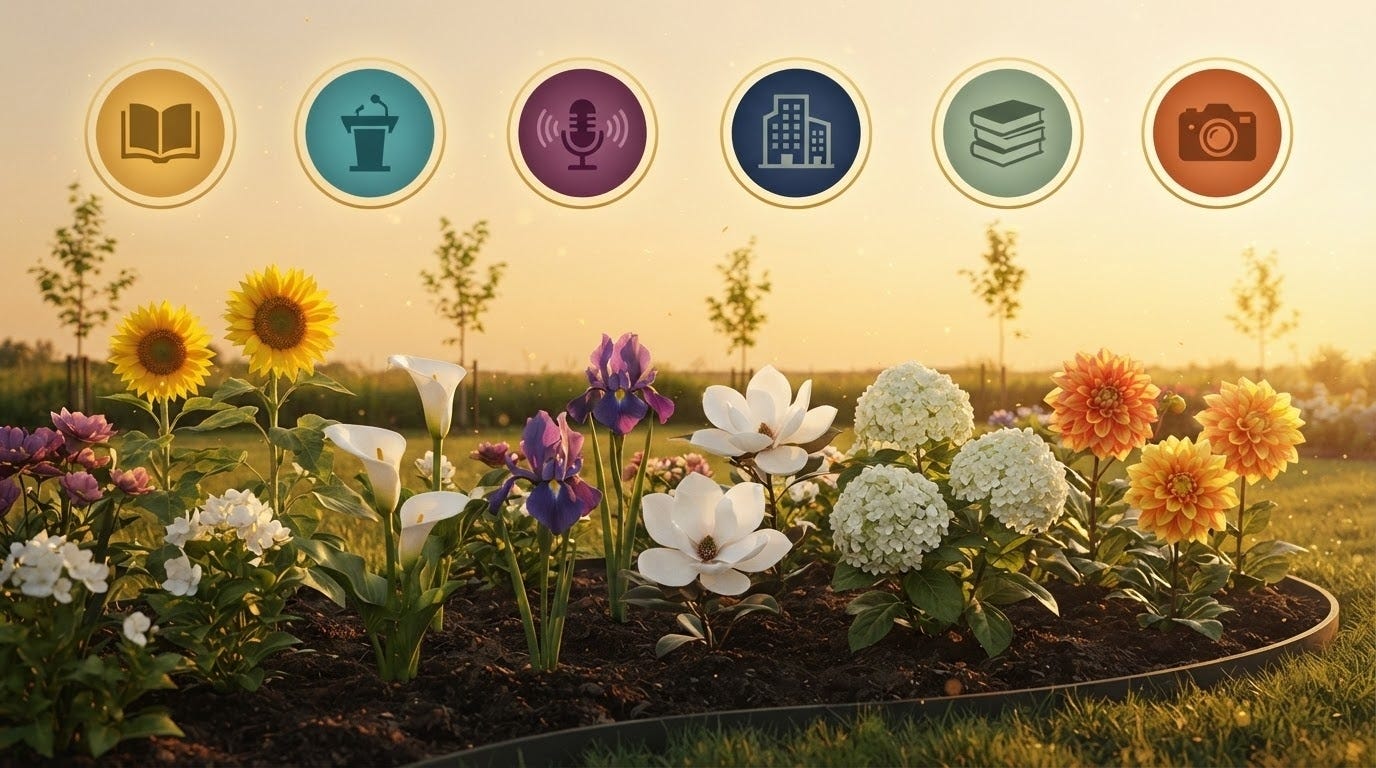
“All the flowers of tomorrow are in the seeds of today.”
When I first read that proverb, I thought immediately of nonfiction authors.
Everyone wants the flowers.
More book sales. Speaking invitations. Podcast interviews. Corporate clients. Bulk book orders. Media attention.
Here’s the problem: most authors spend their energy picking flowers instead of planting seeds. They chase the visible win and skip the invisible work that produces it. That’s why marketing feels frustrating for so many of you. You’re looking for immediate results from activities built to compound over time, and compounding doesn’t announce itself in week one.
Authority isn’t built overnight. It’s cultivated.
An article you publish. A relationship you build. A speech you give. A question you answer. An email you send. Each one is another seed.
Some bloom quickly. Others take years. What matters is this: they keep producing opportunities long after you’ve planted them, often long after you’ve forgotten you planted them at all.
In this paid edition, I’m walking you through the full Authority Garden, all twelve seeds, with the reasoning behind each one, the mistakes I see most often, realistic timelines, and exactly what to do this week. Think of this as the planting guide I’d hand a client on day one of working together.
🌱 Seed #1: Your Niche Statement
🌸 Flower: Being known as the obvious expert
Why this matters
Your niche statement answers one question: why you instead of someone else?
Without it, you’re another author competing on a crowded shelf. With it, you’re the person people remember and refer, because they can repeat what you do in a single sentence.
Here’s what most authors miss: your niche statement isn’t a tagline you write once and forget. It’s the filter every future decision runs through. Which podcasts to pitch. Which article to write next. Which speaking topic to pursue. Get this seed wrong, or leave it vague, and every other seed on this list grows in the wrong direction.
I recently worked with Joan, who described herself as a “leadership and communication expert who helps people succeed.” Nobody remembered her, because that sentence describes half the coaches on LinkedIn. So, we rebuilt it: “I help mid-level managers stop avoiding hard conversations with their teams.” A month in, she pulled me aside and said people were now introducing her at networking events using her own words, word for word. The guessing games were over.
How to plant it
Complete this sentence: I help ______ achieve ______ without ______.
Keep refining it until a stranger understands what you do in under ten seconds, out loud, without rereading it.
Common mistakes
Trying to help everyone, which means you resonate with no one
Talking about yourself instead of your reader’s problem
Using industry jargon that sounds impressive and says nothing
Changing your positioning every few months, which resets the seed before it roots
How long before it blooms
Immediately. Every conversation gets clearer. Every introduction gets easier. This is the one seed with a near-instant flower, and it’s also the seed everything else depends on.
Plant this seed this week
Rewrite your LinkedIn headline or website homepage so a stranger understands exactly who you help in under ten seconds.