


Which book marketing idea have you been meaning to try?
Perhaps you heard about selling books through associations. You can picture your book helping their members, but you haven’t approached anyone.
Before another week fills up, let’s turn that idea into something you can do.
You’ll need your notes, your calendar, and about 20 minutes to choose your first step.
Start with the obstacle in front of you
An idea can sound useful and still be wrong for your current needs.
Suppose you attend a session about creating videos. You leave excited about recording a series. Yet you’re still struggling to explain who your book helps.
Making videos could leave you repeating a message your intended readers don’t recognize as relevant.
Your first task is to clarify that message. The videos can wait.
Choose an idea because it addresses a problem in your marketing.
Complete this sentence before you review your notes.
The obstacle holding back my book marketing is __________.
Be specific. “I need more visibility” gives you little direction. “I don’t know which organizations serve my readers” gives you a place to begin.
Put one idea through this filter
What could your first move look like?
Get three book marketing examples, outreach messages you can adapt, and your downloadable 72-Hour Action Plan. Plus, discover which tempting idea deserves a pass.
Upgrade to paid and put one idea to work.
Find an idea in your notes that could address your obstacle. Then ask yourself these three essential questions…
Who could this help me reach? Name a group of people who need what your book offers.
How does it support my current goal? Explain the connection to a result you want.
What could I do within three days? Choose a step you can complete with the time and resources you have.
If your answers feel vague, narrow the idea before you commit to it.
For example, “get on podcasts” becomes more useful when you define the audience.
Find a podcast for family caregivers where I could discuss how to recognize communication problems caused by hearing loss.
Now you know what to look for.Look for a use before you look for a buyer
Who could this help me reach? Name a group of people who need what your book offers.
How does it support my current goal? Explain the connection to a result you want.
What could I do within three days? Choose a step you can complete with the time and resources you have.
If your answers feel vague, narrow the idea before you commit to it.
For example, “get on podcasts” becomes more useful when you define the audience.
Find a podcast for family caregivers where I could discuss how to recognize communication problems caused by hearing loss.
Now you know what to look for.
Example 1. Turn a podcast lesson into a pitch
Imagine your book helps new managers handle difficult conversations. You’ve learned that podcast interviews could introduce your expertise to people who need it.
You search for leadership podcasts and find one aimed at first-time managers. An episode about giving feedback catches your attention.
As you listen, you notice an opening. The conversation covers what a manager should say, but gives little attention to what happens when an employee becomes defensive.
Your book addresses that problem.
Your action items
Listen to one episode of a podcast that serves your intended readers.
Note a question you could help the host explore.
Write a short pitch connecting your expertise to that question.
Send it using the show’s guest submission process.
Your pitch could read like this.
Your episode on giving feedback raised a challenge many new managers face. What happens when an employee becomes defensive?
My book, [title], helps new managers prepare for these conversations. A discussion about responding to defensiveness could give your listeners a way to keep a difficult conversation productive.
Would this topic fit a future episode?
Personalize the message using what you heard. Follow any submission instructions the host provides.
For this first attempt, measure whether you found a suitable show and sent a relevant pitch. A booking may take longer.
Example 2. Give an organization a reason to use your book
Suppose your book helps adults manage the responsibilities of caring for an aging parent.
You hear that organizations can buy books in bulk. Your first thought is to ask a local employer to purchase copies.
Before you approach anyone, consider where the book could serve a purpose.
You find an employer with a caregiver employee resource group. Your book includes a section about preparing for conversations with siblings over care responsibilities.
That topic could fit a group discussion.
Your action items
Find one organization with a program connected to your book’s subject.
Read about the program and the people it serves.
Identify one situation where your book could help.
Contact the person responsible for the program.
You could begin with this.
I noticed your caregiver group supports employees who are caring for family members.
My book, [title], includes guidance on discussing care responsibilities with siblings. Could that topic be useful for a future group session?
Who would be the best person to speak with about your program?
The purpose of this message is to discover whether there’s a fit.
If there is interest, ask about the group’s needs before proposing a session or a quantity of books.
Your first useful result might be finding the right contact. Record that progress and decide what comes next.
Example 3. Follow up on a possible speaking opportunity
Imagine you meet someone at an event who mentions that her association needs speakers.
Your book addresses an issue its members face. You have a promising conversation, then go home thinking you need a speaker sheet before you can follow up.
Start by finding out more about the opportunity.
Your action items
Write down what the person said about the association.
Choose one problem you could help its members address.
Send a follow-up referring to your conversation.
Ask for an introduction or the appropriate contact.
Your message might say this.
It was a pleasure talking with you at [event]. Your comment about members struggling with [problem] stayed with me.
My book, [title], addresses that issue, and I’d like to learn more about what your association needs from its speakers.
Would you feel comfortable introducing me to the person who plans your programs?
If an introduction follows, ask about the audience and the purpose of the event. You’ll have better information for shaping a session.
An appealing idea to set aside
You attend a workshop on launching a YouTube channel. You like the idea of reaching readers through video.
But your immediate goal is to develop speaking opportunities with professional associations. You have two hours a week for marketing and several contacts you haven’t followed up with.
Starting a channel would require you to learn a new process and build an audience. Following up with those contacts has a clearer connection to your current goal.
For now, save the video idea with a note explaining when you might reconsider it.
A useful idea doesn’t have to become your next project.
Build your 72-hour plan
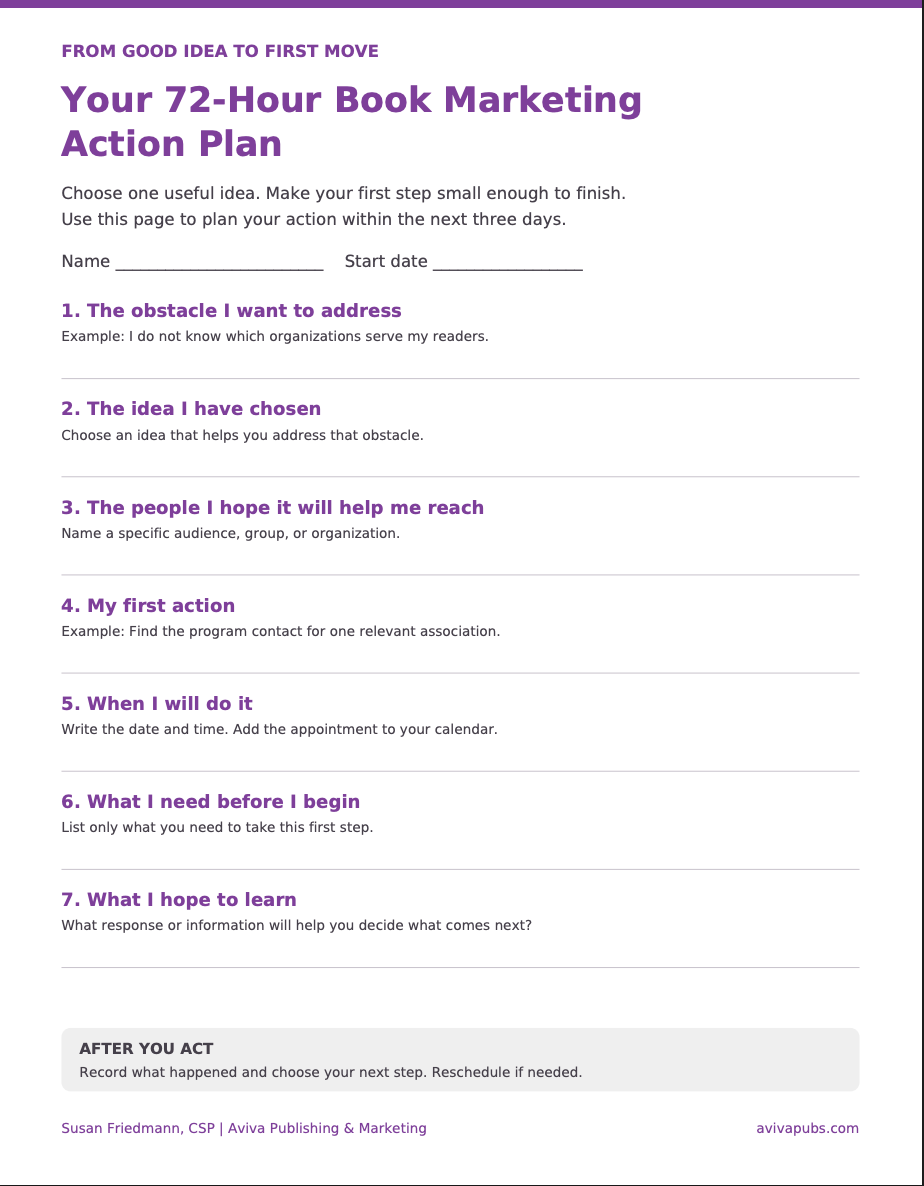
Put the appointment on your calendar. If the task feels too large for the time available, reduce its scope.
“Research associations” could occupy an afternoon. “Find the program contact for one association” has a finish line.
Decide what happens after the first move
Once you’ve acted, record what happened. Use the response to guide your next decision.
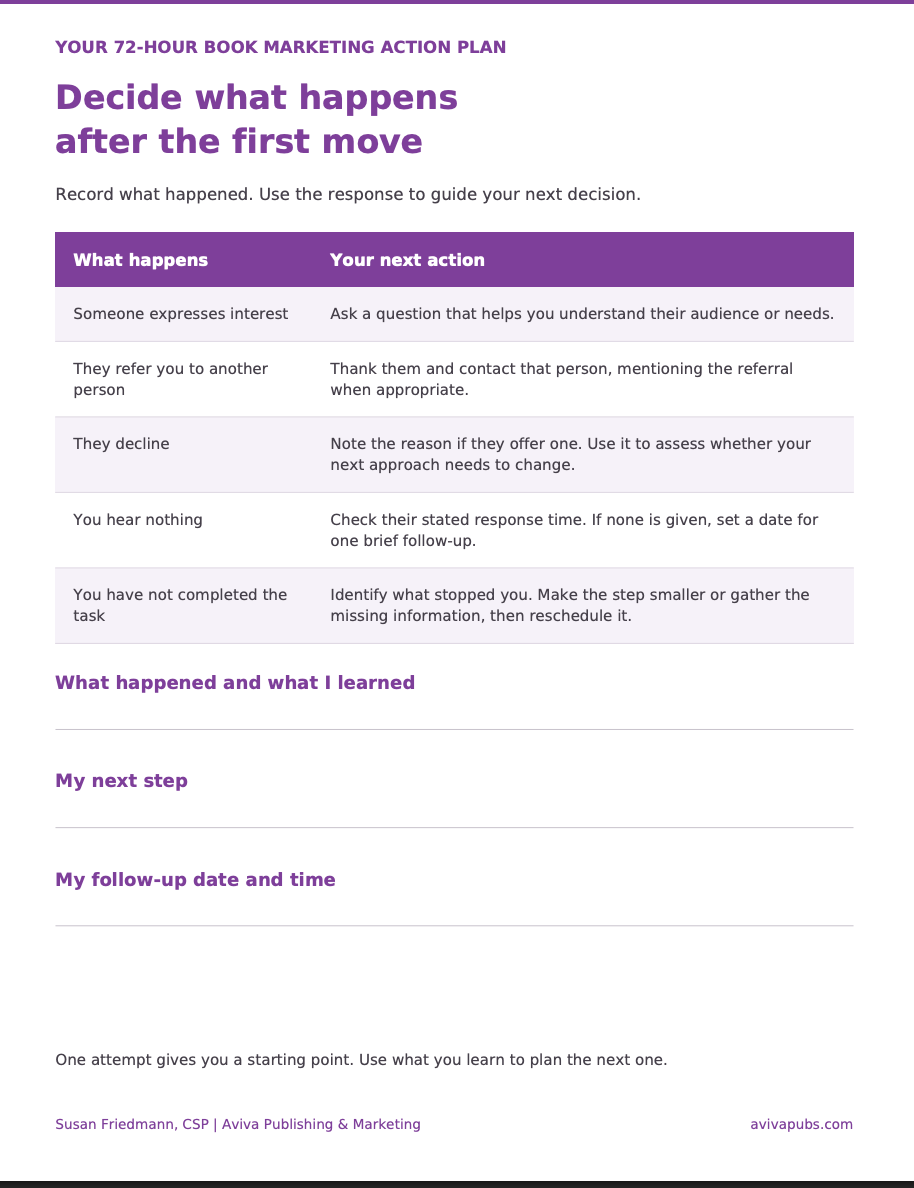
One attempt gives you a starting point. You’ll need more experience before deciding whether an approach deserves a larger place in your marketing.
Leave with a decision
Look at the plan you’ve completed.
Does the action address your obstacle? Can you finish it with the time you’ve allowed?
If so, you have enough to begin.
What will you do in the next 72 hours to give one idea a chance?
P.S. Thanks for being a paid subscriber - you make a difference, and I appreciate you! :)