


Who already has access to the people your book could help?
That question can take your marketing further than another round of asking friends to share your Amazon link.
Your intended readers already belong somewhere. They attend training programs, join associations, and turn to organizations for guidance. Some employers provide resources to help them through a challenge.
Your job is to discover where your expertise fits into the work those organizations do.
A bulk book opportunity begins with a useful purpose for the book.
Before you build a prospect list, get clear about that purpose.
Give someone a reason to need your book
“Anyone interested in personal growth” gives you little direction. You could spend months chasing that audience without knowing whom to approach.
A specific situation gives you somewhere to start.
Imagine an author whose book helps people manage difficult conversations. A company has promoted several employees into supervisory roles. Those new managers now have to address performance problems with former peers.
The author has something relevant to offer at a moment when the company needs it.
Complete this sentence for your book.
My book helps __________ when they’re facing __________, so they can __________.
For example—
My book helps first-time managers handle difficult conversations so they can address problems before they damage the team.
If you struggle to fill in the blanks, pause here. A vague answer will produce a scattered prospect list.
Look for a use before you look for a buyer
Who could buy your book in bulk, and how do you get the conversation started?
Keep reading to identify five potential buyers, spot where your book fits their programs, and find the person to approach. You’ll get a prospect worksheet and a sample email you can adapt, so you can send your first pitch with confidence.
Look for a use before you look for a buyer
An organization needs a reason to put your book into someone’s hands.
Could it support a workshop? Help new members get started? Give participants something to use after a conference?
Think about what happens before and after someone receives it.
A retirement guide might support an adviser’s client education event. Participants could use the book afterward to continue conversations with their families.
Now the adviser can see a purpose for purchasing copies.
“Your clients might like my book” is a weak pitch. Explain how they could use it.
Write down one practical use for your book inside an organization. Keep it small enough to explain in a few sentences.
Build a list of five organizations
Start with organizations whose existing work connects to the situation you identified.
For a book about first-time leadership, you might investigate an employer with a supervisor development program. A professional association serving emerging leaders could be another possibility.
A leadership trainer might also become a partner who includes the book in a paid program. In that case, explore how your expertise complements their work before proposing a collaboration.
You’re looking for evidence of a fit.
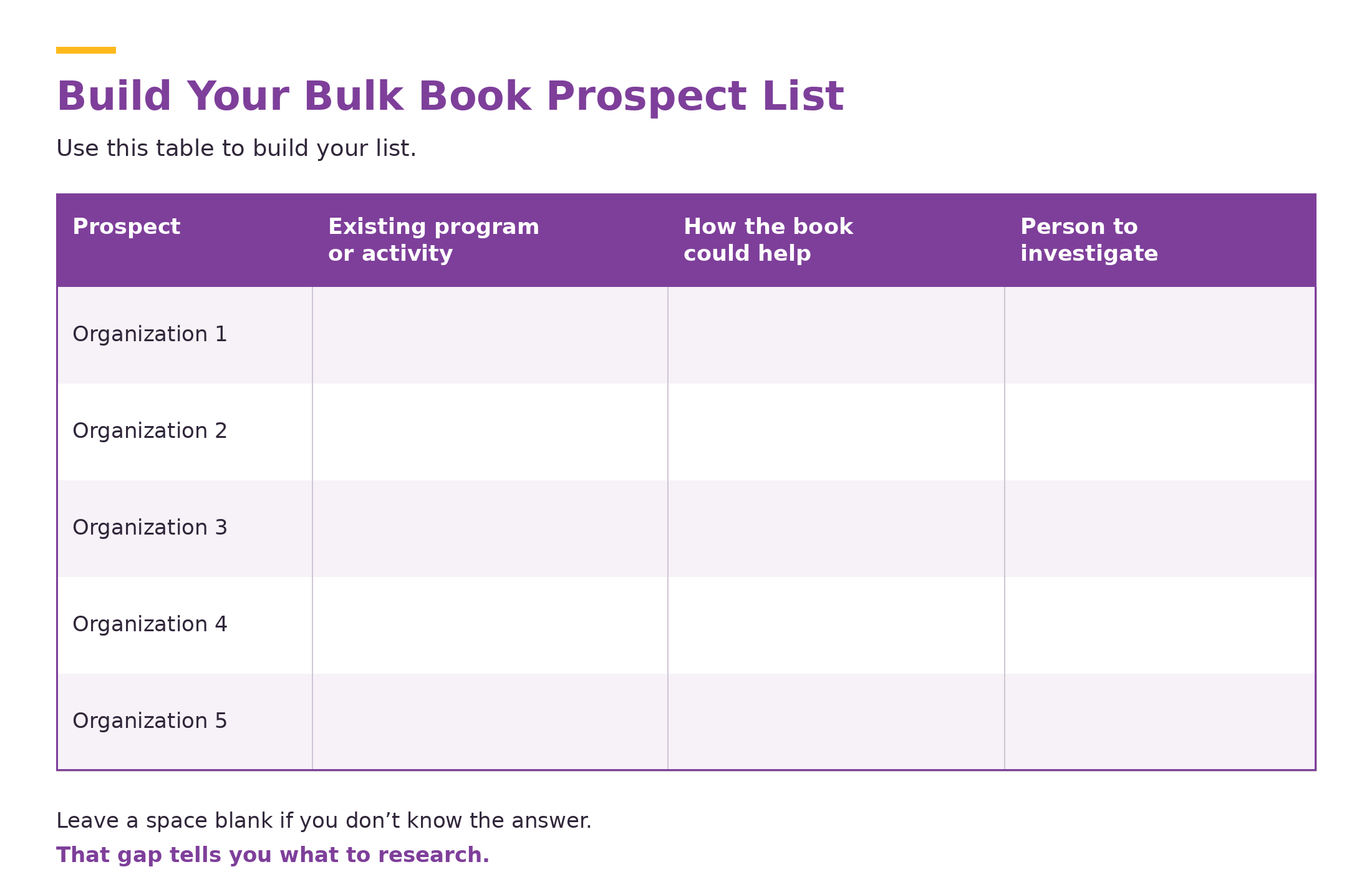
An organization that serves your readers may be a useful introduction source without being a buyer. Look for signs it purchases materials or has a program where someone else could fund the books.
Find the person responsible for the result
The executive director may have little involvement in selecting resources for a training program.
Look for the person who owns the activity your book could support. Depending on the organization, that might be a learning and development manager, a member education director, or a program coordinator.
Their role gives you clues about what matters to them.
Someone running a conference may want attendees to leave with tools they’ll use. A training manager may need employees to apply what they learned after a session.
Your opening conversation should connect to that responsibility.
If you can’t identify the person, ask—
Who oversees resources for your new manager training program?
That question gives someone a clear way to direct you.
Choose your strongest prospect
Before reaching out, check whether you can answer these questions.
Does this organization serve the readers I’ve identified?
Can I name an existing activity my book could support?
What suggests the need matters to them now?
Who could explain how they select and purchase resources?
Prioritize the prospect where you have the clearest answers.
A recognizable organization with thousands of members can be tempting. A smaller organization with a relevant program and an accessible decision-maker may give you a better place to begin.
Send an email that opens a conversation
Your first email has a modest job. Help the recipient recognize the relevance and make it easy to respond.
Subject — A resource for your new manager program
Hi [First name],
Your [program name] caught my attention, particularly its focus on helping new supervisors handle team challenges.
My book, [Title], helps new managers tackle tough conversations with confidence so small problems don’t become team conflicts. Practical exercises help participants put your training to work when they’re back on the job.
How do you currently choose follow-up resources for the program?
If this falls within your role, I’d welcome a brief conversation to explore whether the book could be useful.
Warmly,
[Your name]
Adapt the email to something you’ve verified about the organization. Keep the claim about your book specific and accurate.
A relevant question gives you more to work with than a long list of reasons your book is wonderful.
Use the conversation to discover the opportunity
If someone responds, resist the urge to rush into a quantity discount.
Find out how the program works. Ask what participants struggle with and which resources they already use. Explore who approves purchases and when those decisions happen.
You may discover a fit for a small pilot order. The conversation could also reveal that a workshop would help the organization use the book.
Let what you learn shape the proposal.
Put five prospects on your calendar this week
Set aside one short session to define the reader’s situation and a practical use for your book.
Use your next session to research five organizations. Then choose the strongest fit and send one thoughtful email.
Record what you learn. A reply that explains why the book doesn’t fit can help you sharpen your next approach.
You’re building a repeatable way to find opportunities beyond the people who know you.
Which organization already serves the reader you most want to help? Start there.
P.S. Thanks for being a paid subscriber - you make a difference, and I appreciate you! :)