

I hear the same concern almost every week.
“Susan, if AI can write a book in minutes, why would anyone read mine?”
It’s a fair question. Authors ask it in coaching calls, in Facebook groups, in the anxious 11 p.m. emails that land in my inbox when a launch date feels too close and the competition feels too big.
But I think it’s the wrong question.
The better question is this: What can you bring to the page that AI never will?
Readers aren’t shopping for information anymore
After more than 30 years working with nonfiction authors, I’ve become convinced of something most writers don’t want to hear: readers aren’t looking for more information. They’re drowning in it. A single Google search hands them ten thousand answers to almost any question they could ask.
What readers can’t get from a search bar is someone they can trust.
Think about the last time you picked up a business book, a health guide, or a memoir that changed how you saw something. You didn’t finish it because the facts were airtight. You finished it because a person showed up on the page, someone who’d been where you are and had scars to prove it. Facts inform. People persuade.
That’s where so many authors underestimate themselves. They assume their value lives in the information they’ve gathered. It doesn’t. It lives in you.
What AI can do, and what it can’t
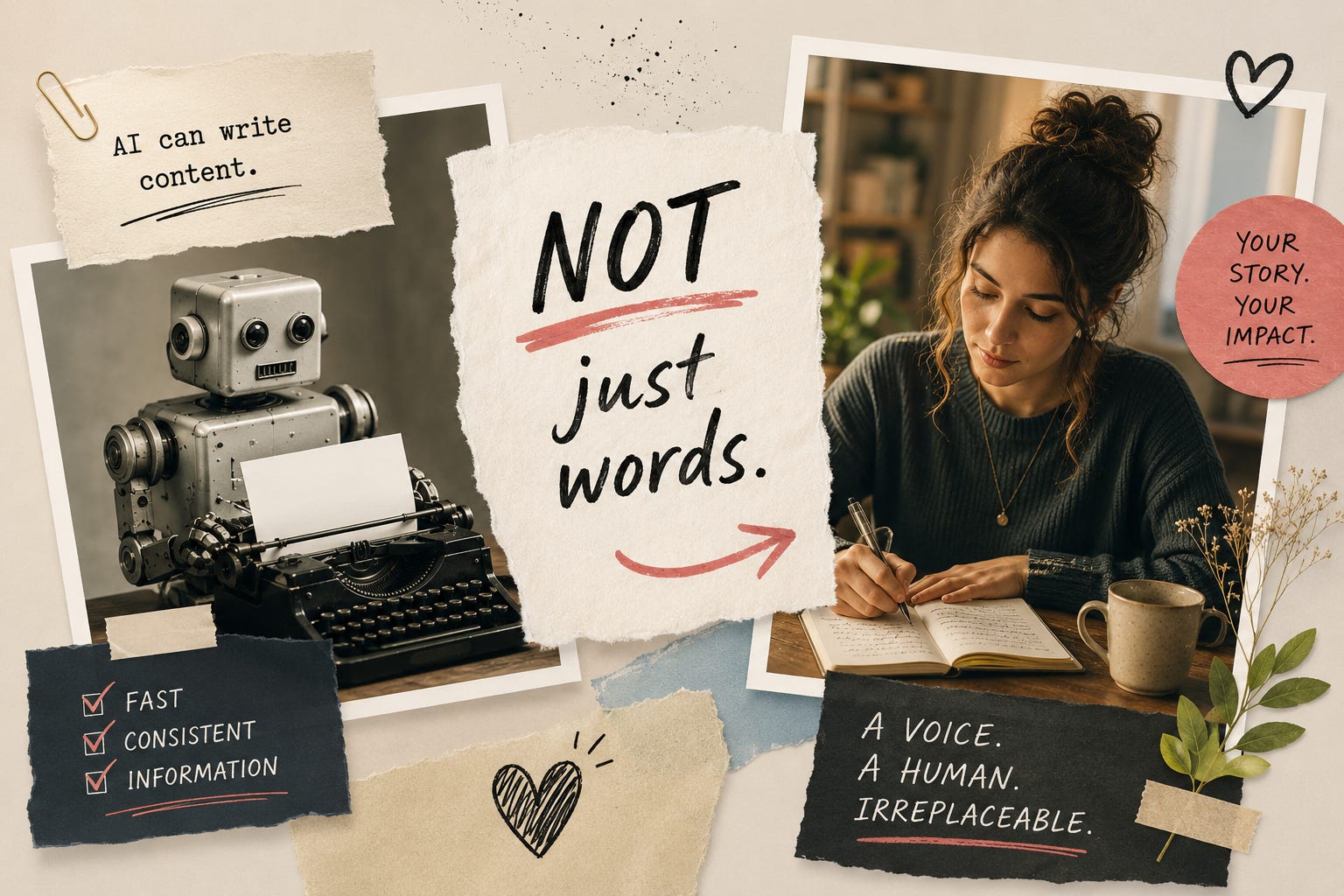
AI can organize ideas. It can summarize research in seconds. It can even produce prose that sounds surprisingly polished, the literary equivalent of a well-tailored suit on a mannequin. Impressive to look at. Nobody home inside it.
What AI can’t do is replace your experience.
It can’t replace the lesson you learned the hard way, the one that cost you a client, a year, or a night’s sleep. It can’t replace the mistake that rewired your thinking and made you better at your craft. It can’t replace the judgment you’ve sharpened over years of showing up, failing, adjusting, and showing up again.
That accumulated wisdom is your authority. No algorithm can manufacture it, because authority isn’t assembled from data. It’s earned through experience nobody else has lived.
The quiet way authors give their authority away
The real issue isn't AI. Most authors don’t hand over their authority on purpose. It happens gradually, one shortcut at a time.
They ask AI to write the first draft, thinking they’ll add their personality later. Then life gets busy, the deadline looms, and “later” never quite arrives. They spend their editing time polishing AI’s ideas instead of excavating their own. Sentence by sentence, their voice fades into the background, like a photograph left too long in sunlight.
The result is a book that’s technically well written and sounds like everyone else’s book. Competent. Forgettable. A stranger wearing your name on the cover.
Your book is not a product you assemble. It’s closer to raising a child: messy, personal, shaped by your specific fingerprints, impossible to outsource without losing the thing that made it yours in the first place.
What I tell my clients instead
Write your opinion first. Write what you believe before you write what you’ve researched. Write why it matters to you, specifically, not why it matters in general.
Once your voice is on the page, invite AI in as a research assistant or an editor. Let it check your grammar, organize your outline, or suggest a sharper structure. Use it as a tool that serves your thinking.
Never let it become a replacement for your thinking.
Here's what I've discovered
We’re heading into a world flooded with AI-generated content, articles, and books that all sound faintly like each other because they were trained on the same ocean of text. Ironically, that flood makes authentic human insight more valuable than it’s been in decades.
Your stories matter. Your perspective matters. Your voice, with its particular rhythm and its particular scars, matters more now than it did five years ago.
Readers don’t just buy books. They buy confidence. They buy clarity. They buy someone who has already walked the path they’re trying to navigate and can hand them a map with the dead ends marked.
That’s something no algorithm, no matter how sophisticated, can ever manufacture.
Question for you: Has AI helped strengthen your voice, or have you caught yourself sounding more like AI than yourself? Let me know!
Key Takeaways:
Your voice is your greatest competitive advantage. AI can generate words, but it can’t replicate your experience, perspective, or judgment.
Readers don’t buy information. They buy trust. Your lived experience is what makes your book credible and memorable.
Use AI as a tool, not a replacement. Let it help with research and organization, but never outsource your thinking.
Authority comes from what only you know. The lessons you’ve learned, the mistakes you’ve made, and the insights you’ve earned are impossible for AI to duplicate.
In an AI-filled world, authenticity becomes more valuable, not less. Your humanity is what will help you stand out.
So How Do You Protect Your Voice?
If this article resonated with you, the paid edition goes beyond why your voice matters and shows you how to protect it.
I’ll share the seven rules I use to make AI a valuable assistant without letting it take over my thinking or writing.
If you want your book to sound unmistakably like you while still benefiting from AI, that’s where Thursday’s article goes.
Each week, my paid subscribers receive an in-depth companion article that goes beyond the ideas and into the implementation. You’ll get the strategies, frameworks, examples, templates, worksheets, and “Authority Tools” I use to help nonfiction authors become the recognized experts in their niche.
As a paid subscriber, you’ll also unlock the Author Authority Vault, a growing library of premium resources, including:
Step-by-step implementation guides
Downloadable planners and worksheets
Authority-building templates
Exclusive workshops and training
Practical tools you can use immediately
In-depth articles that take each topic further
My goal isn’t to give you more marketing tactics.
It’s to help you build lasting authority so your book opens doors to speaking engagements, consulting opportunities, strategic partnerships, media interviews, and bulk book sales.
If you’re ready to stop collecting marketing ideas and start building your authority, I’d love to welcome you inside the Author Authority Vault.
Become a paid subscriber today and start turning your book into your most powerful authority-building asset.